

This is an excerpt from my latest Washington Post Intelligence report. Free link to the full report at the bottom.
Since returning to power last year, the Trump administration has pursued policies on illicit finance that appear to be working at cross-purposes. Washington is now running an aggressive campaign of financial pressure against Western Hemisphere-based drug cartels, the Iranian regime and other targets of the administration’s agenda. Simultaneously, the U.S. government has weakened the infrastructure that had been built up to help law enforcement combat illicit capital flows.
The administration has rolled back the Corporate Transparency Act, legislation aimed at providing law enforcement and financial institutions greater visibility into structures designed to obscure the presence of criminal actors. And the administration has narrowed the use of the Foreign Corrupt Practices Act, aimed at preventing bribery.
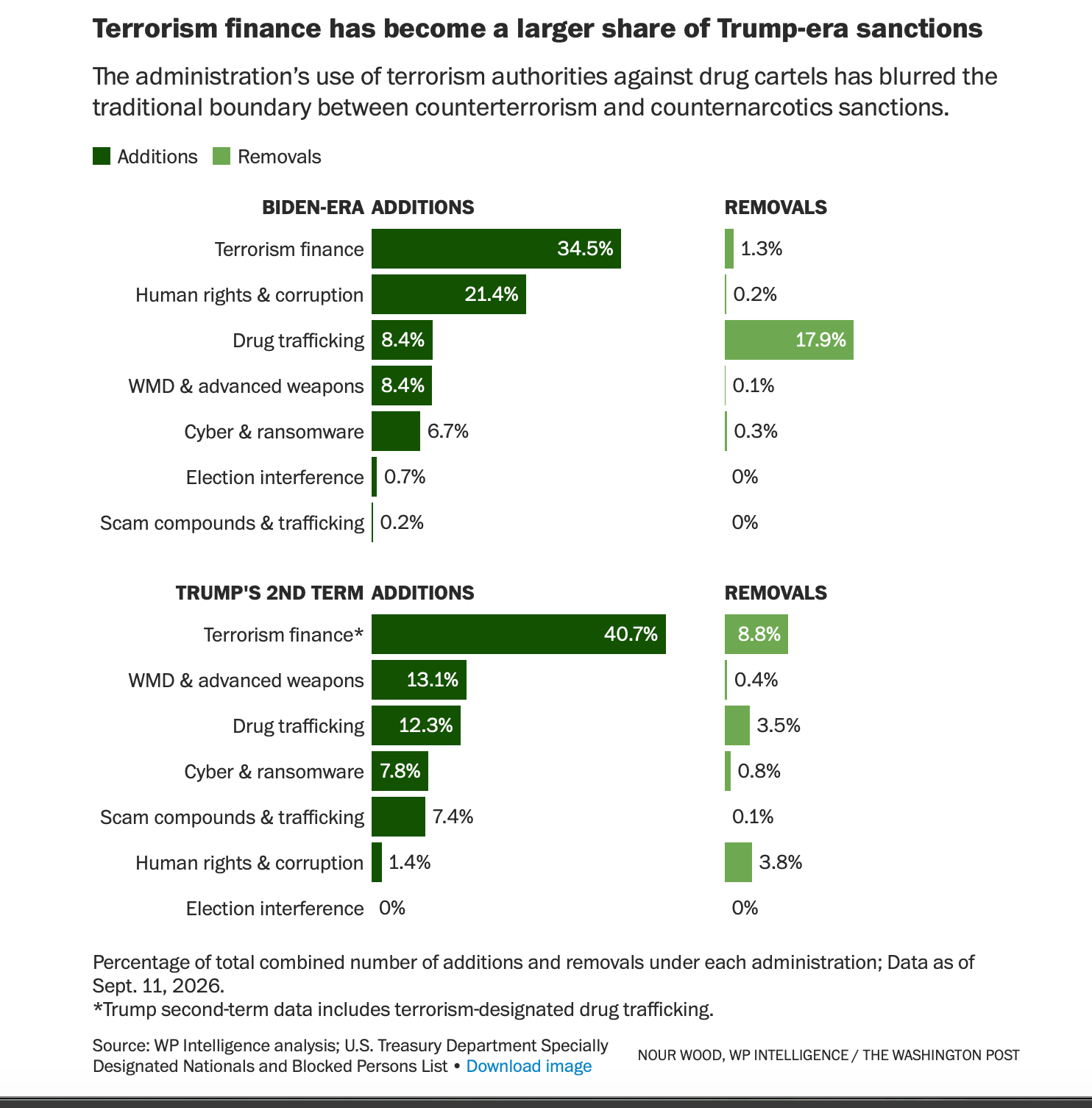
On the other hand, it has taken a more aggressive approach using counterterrorism authorities in new ways to go after cartels and their businesses, re-designating 18 transnational criminal organizations (TCOs) as foreign terrorist organizations (FTOs). Other new administration illicit finance enforcement campaigns are aimed at Cuba, Somalis in Minnesota accused of fraud and what the administration calls “far-left terrorism”organizations such as antifa.
“It’s a dual message,” said Elaine K. Dezenski, head of the Center on Economic and Financial Power (CEFP) at the Foundation for Defense of Democracies. “On the one hand, the administration wants to go after cartels and criminal organizations that are evading their tariffs and sanctions. At the same time, they’ve rolled back really important tools like the Corporate Transparency Act (CTA), which are designed to go after those same threats.”
In August, the administration unveiled Operation Economic Outcast, which Treasury Secretary Scott Bessent called the economic equivalent of D-Day. The campaign promises to institute secondary sanctions on any country or company that aids the Iranian regime in a long list of industrial sectors — including but not limited to shipping, aviation, gold, technology, and digital assets.
All of these U.S. government efforts depend on an enforcement system that is undergoing great strain. Senior positions in key U.S. government agencies remain without confirmed appointees. Hundreds of bureaucrats at the Treasury, Commerce, State and Justice Departments working on these issues were let go at the beginning of the administration, and many more left of their own accord.
“In the enforcement agencies, offices have been gutted, resources are down, and really talented people, even if they haven’t been fired, are looking to leave,” a former senior Treasury Department official told WP Intelligence, speaking on the condition of anonymity to avoid retaliation. “So you don’t have the muscles there to enforce even on the priorities where the administration wants to. And that dilution weakens deterrence.”
Matthew Zweig, senior fellow at FDD, said the key dynamic is the tension between the administration wanting to do more to combat illicit finance in certain cases while wanting to loosen the rules in others.
“What you’re seeing is the classic clash between an administration pursuing a deregulatory cycle and, at the same time, needing to safeguard the system to pursue their policy priorities,” he said.
The Treasury Department did not respond to detailed questions about these policies.
The result has been a policy and enforcement landscape that presents businesses with a vexing dual challenge: Operating in foreign countries and navigating the domestic enforcement regime are both now more volatile and unpredictable tasks.
Read the entire report here: https://wapo.st/4yDcD86