


This is an excerpt from my latest Washington Post Intelligence report. Free link to the full report at the bottom.
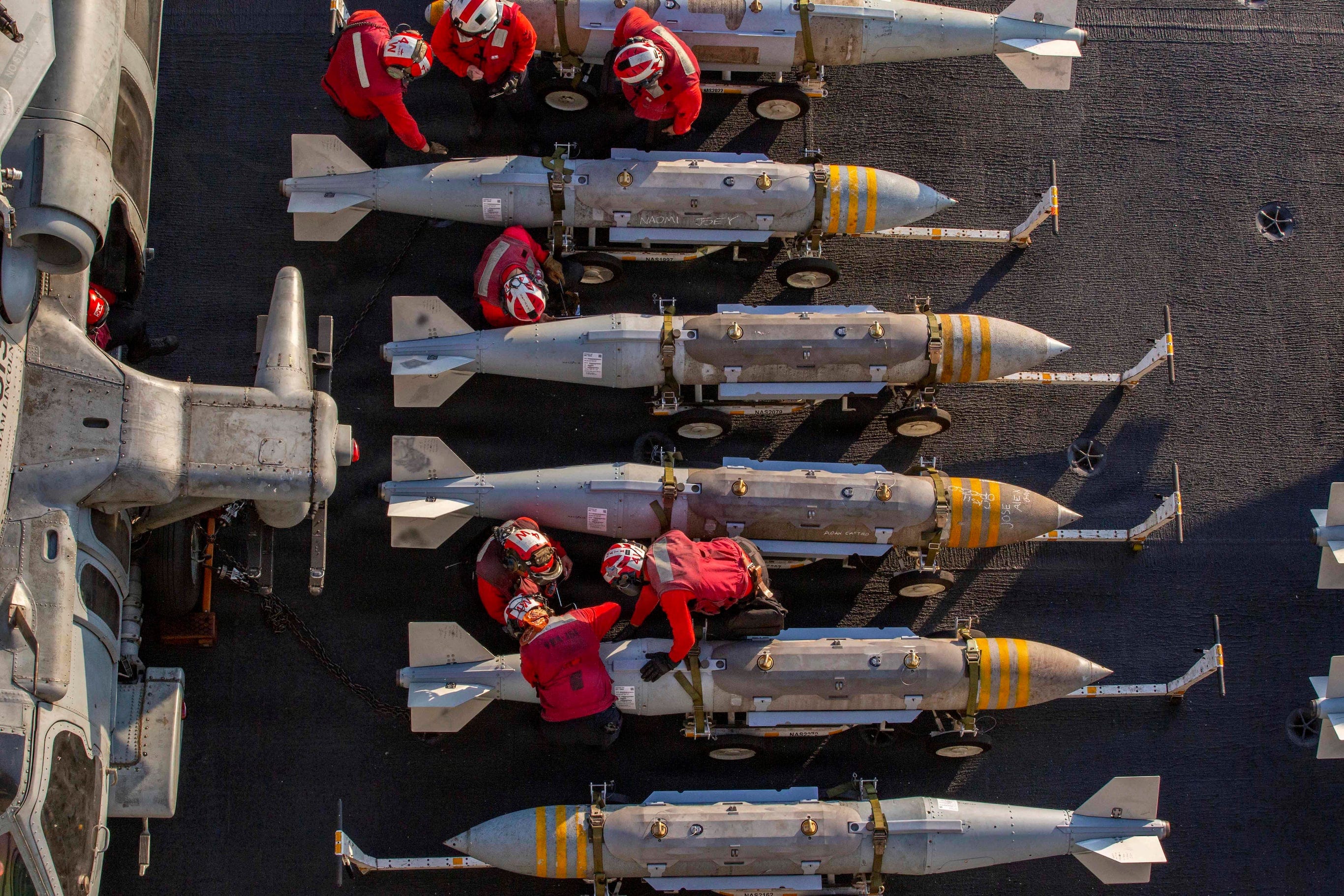
During the major combat operations in the Iran war, the Navy’s destroyers and submarines fired so many Tomahawk cruise missiles that the United States had expended more than it produced in a last decade, according to an independent analysis in May by the Center for Strategic and International Studies. A new report released by CSIS Monday shows that Patriot interceptors and Terminal High Altitude Area Defense (THAAD) missile interceptors, both of which are in demand across the world, were expended at a rate that has left about half of the prewar U.S. inventory of each munition depleted.
The Pentagon’s official and consistent stance has been to downplay the stockpile concerns raised by lawmakers, analysts and experts. “The munitions issue has been foolishly and unhelpfully overstated,” Defense Secretary Pete Hegseth told a House Appropriations subcommittee in May. “We have all the munitions needed to execute what we need to execute.” At a reporter roundtable on the sidelines of a Center for a New American Security event in June, Michael Cadenazzi, assistant secretary of war for industrial base policy, pushed back on the premise that current stockpiles could not sustain large-scale combat operations. “I think that’s fundamentally flawed,” he said. “I don’t think that’s based in fact.”
In an interview with WP Intelligence, Rep. Pat Ryan (D-New York), a West Point graduate and Iraq War veteran who sits on the House Armed Services Committee, alleged the administration is hiding the extent of the problem. Ryan co-chairs the bipartisan House Defense Modernization Caucus, and he has in several hearings pressed Pentagon officials and combatant commanders for a detailed accounting of what the war has consumed.
“There is still not a single classified or unclassified accounting that has been shared with the committee, despite multiple requests from members of both parties,” Ryan said. “And how do we fix this if we don’t understand what our current situation is?”
The May CSIS analysis is among the most rigorous public assessments available, based on unclassified Defense Department budget documents, news releases and other public reporting. CSIS estimated that Patriot interceptor stocks won’t be replenished until mid 2029, THAAD interceptors stocks will not reach pre-war levels until mid to late 2029, and Tomahawk missiles stocks won’t return to pre-war levels until late 2030 or early 2031. Similar production gaps face other missile replenishment efforts.
Since major combat operations with Iran have ended, the Trump administration has taken several steps on replenishment, even while denying the scope of the problem. On June 24, the Office of Management and Budget transmitted an $87.6 billion emergency supplemental requestto Congress, of which $21 billion is designated for munitions replenishment. That same day, the Pentagon awarded Lockheed Martin a seven-year, up-to-$35.3 billion contract to quadruple production for an anti-ballistic missile weapon known as THAAD interceptor from 96 to 400 units per year.
On June 24, the White House also convened a second meeting with defense company executives that, according to a source cited by Reuters, opened with a blunt message to the CEOs: “You’re not doing enough.” By the end, officials were calling for the companies to “get on a war footing.”
The question now is not whether a large-scale replenishment effort will occur. The harder questions are what will be built, who beyond the established primes will be positioned to build it, and whether an industrial base that took three decades to hollow out can reconstitute and reform itself at the same time.
“These munitions were designed in the 1970s and 1980s. They were built all about performance. They were not built to be mass produced. They’re very exquisite,” said Jerry McGinn, director of the CSIS Center for the Industrial Base. “So it’s really hard to scale them.”
Read the entire report at WP Intelligence here: https://wapo.st/4ygV7XR
Military-Industrial eats up 42% of our national budget, plus an unknown amount of 'dark' money, and we're OUT OF ARMAMENTS? What a crock. Eisenhower was right, he just never imagined how bad it could get, the overwhelming cost of losing every war...
The CSIS timeline is the story underneath the story. Tomahawks not replenished until 2031. THAAD and Patriot not until 2029. Those aren't supply chain data points. They're a published vulnerability window.
Every adversary with a strategy department and a CSIS subscription now knows exactly when the US can repeat Epic Fury and exactly when it can't. The deterrent was never the military itself. It was the stockpile behind it. And the stockpile is now on a publicly available rebuild schedule with year-by-year milestones that any foreign ministry can track in real time.
The Pentagon saying the problem is "overstated" while simultaneously requesting $21B in replenishment funding inside an $87.6B supplemental is the kind of contradiction that answers its own question. You don't ask for $21B to solve a problem you don't have.